Every hospital exploring AI faces the same challenge: determining which models have achieved clinical-grade validation—and which are still maturing. For governance and IT leaders, the central question is not whether AI can help, but whether its outputs can be trusted to perform reliably, reproducibly, and safely in real-world clinical workflows.
AI is no longer experimental in healthcare. It is embedded in documentation, imaging, anddecision-support systems across nearly every health system. Yet beneath this progress lies a critical distinction: not all AI models function the same way. Each class of AI—Natural Language Processing (NLP), Large Language Models (LLMs), and Computational Linguistics (CL)—carries different implications for safety, reliability, traceability, and operational efficiency
As AI adoption accelerates, a new governance challenge has emerged: the validation burden.
The validation burden is the operational cost of verifying AI outputs before they can be trusted for clinical use. When AI systems generate results that still require human confirmation, the efficiency they promise is offset by additional oversight work.
Understanding which model architectures reduce this burden—and which increase it—is now essential for effective AI governance. Each model type contributes distinct strengths to healthcare AI.
Each model type contributes distinct strengths to healthcare AI.
Understanding how these models differ—and how each performs under clinical and operational scrutiny—is now essential for ensuring that AI adoption remains validated, transparent, and sustainable.
In healthcare, real progress is measured by validated performance—by what can be trusted to deliver consistent, safe results.
NLP made it possible to search and structure clinical text. By identifying keywords and simple linguistic patterns—terms such as nodule, aneurysm, or mass—NLP converts narrative text into discrete data fields.
How it works:
NLP relies on statistical and rule-based pattern matching to locate words or phrases of interest in radiology reports.
Where it helps:
Where it falls short:
Governance Perspective:
NLP represented early progress but introduced a persistent validation burden: every outputrequired human verification before clinical use.
.svg)
LLM—the foundation of generative AI—have expanded what language-based systems can do in healthcare. They can synthesize information, summarize records, and reduce documentation workload.
How they works:
LLMs generate language probabilistically, predicting the next word in a sequence based on patterns in large text datasets. They do not extract facts deterministically.
Where they add value:
Where they require caution:
These characteristics can lead to what many governance leaders describe as a validationcascade—a cycle in which clinicians must manually confirm each AI-generated output beforeacting on it. This phenomenon drives the validation burden, where the oversight required to ensure accuracy offsets the efficiency AI is meant to provide.
In practice, inconsistent AI shifts work from data entry to data verification, adding review steps and potential delay
Governance Perspective:
LLMs are powerful for communication and workflow support but require structured validation processes before use in patient-impacting decisions.
.svg)
CL is an advanced evolution of traditional NLP, designed to bring deeper linguistic and clinical understanding to healthcare data. CL applies deterministic logic, linguistic rules, and medical ontologies to interpret text with the precision expected of a clinician.
CL delivers the accuracy and accountability that healthcare requires. By encoding medicallanguage into deterministic frameworks, it ensures that every extracted finding can be traced,verified, and trusted.
How it works:
Real-world performance:
Eon’s condition-specific CL engines—validated across thousands of imaging reports—achieve 99.57 % precision and 99.73 % recall for incidental-finding extraction, substantially reducing manual review compared with earlier NLP systems.
Governance Perspective:
CL aligns with governance priorities. It is deterministic, transparent, and auditable—reducing manual validation and supporting regulatory compliance.
.svg)
The evolution of clinical AI reflects a growing recognition that validation is universal, though itsburden differs by model. Eon’s experience over the past decade illustrates that trajectory and the lessons many health systems have learned firsthand:
.svg)
When evaluating AI for clinical deployment, four attributes should be non-negotiable.They determine whether an AI model reduces—or perpetuates—the validation burden.
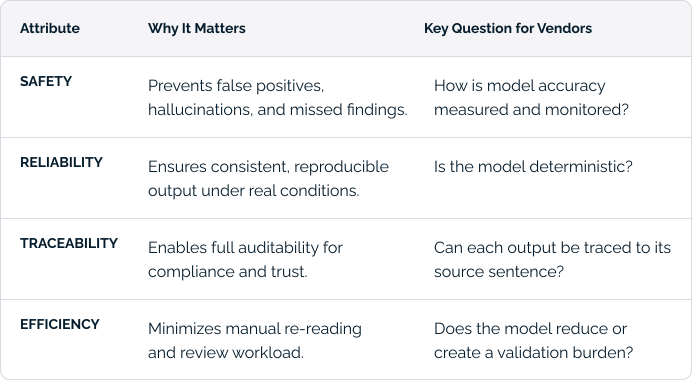
The next phase of healthcare AI will be defined not by how much language it can generate, but by how effectively it can validate its own results. Systems that embed verification and traceability will establish the next standard for clinical trust.
Healthcare requires validated AI—systems that are accurate, explainable, and consistent.
The next generation of healthcare AI will be defined by safety, transparency, and accountability.
The most trusted systems will embed validation into every process, ensuring that outputs are reliable, reproducible, and clinically sound.
Understanding the underlying model—NLP, LLM, or CL—is the first step. The next is to reduce the validation burden so AI can deliver both safety and efficiency at scale.
Because in healthcare, trust is earned through validation.